The Obsessed!1 festival, initiated by Current Obsession (CO)2, is an international and multifocal platform for contemporary jewellery, widely recognized under its abbreviated name. The theme of the 2025 festival was “Glow-Up”. Within this framework, the events addressed adornment as an act of identity and empowerment, examining jewellery as a tool for self-expression, transformation, and awareness. Alongside the exhibitions, a symposium explored the interplay between identity and creation, deepening the understanding of the environmental complexities that accompany the field. Meanwhile, a youth panel focused on identity, storytelling, and sources of inspiration within contemporary jewellery.
All festival events relate to the body operating within a material and perceptual environment of our time. They position jewellery at the intersection of material, use, identity, and social contexts, proposing the notion of a “jewellery-adornment” as a cultural practice rather than merely a decorative object. A worn piece of jewellery carries a network of signs that speak of its wearer, its maker, and the society in which they live, turning the act of wearing itself into a social and cultural gesture rather than a purely aesthetic one.
This List focuses on a single day of wandering in Amsterdam during the festival – between galleries, studios, workshops, and exhibitions – and seeks to share my notes and personal experiences.
The Pool –
Amsterdam Jewellery Collective
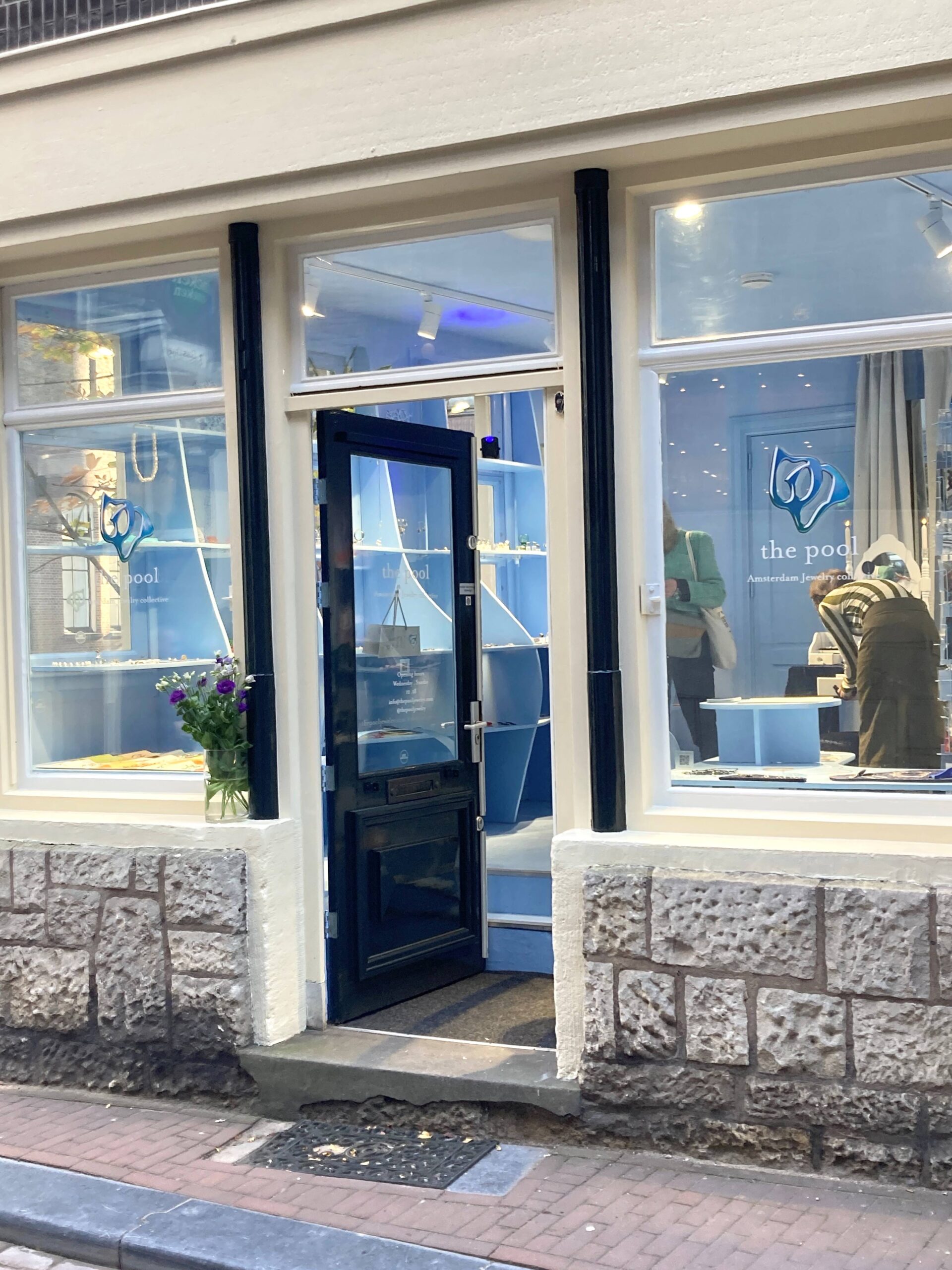
I felt it was appropriate to begin my rambling of the events with a first visit to The Pool, an independent contemporary jewellery collective in Amsterdam, founded in 2020. The collective brings together about fifteen makers at various stages of their careers, working in a wide range of unique approaches to material, form, and idea, and making the field accessible to a broader audience. The space also operates as a shop, where their works are displayed and sold.
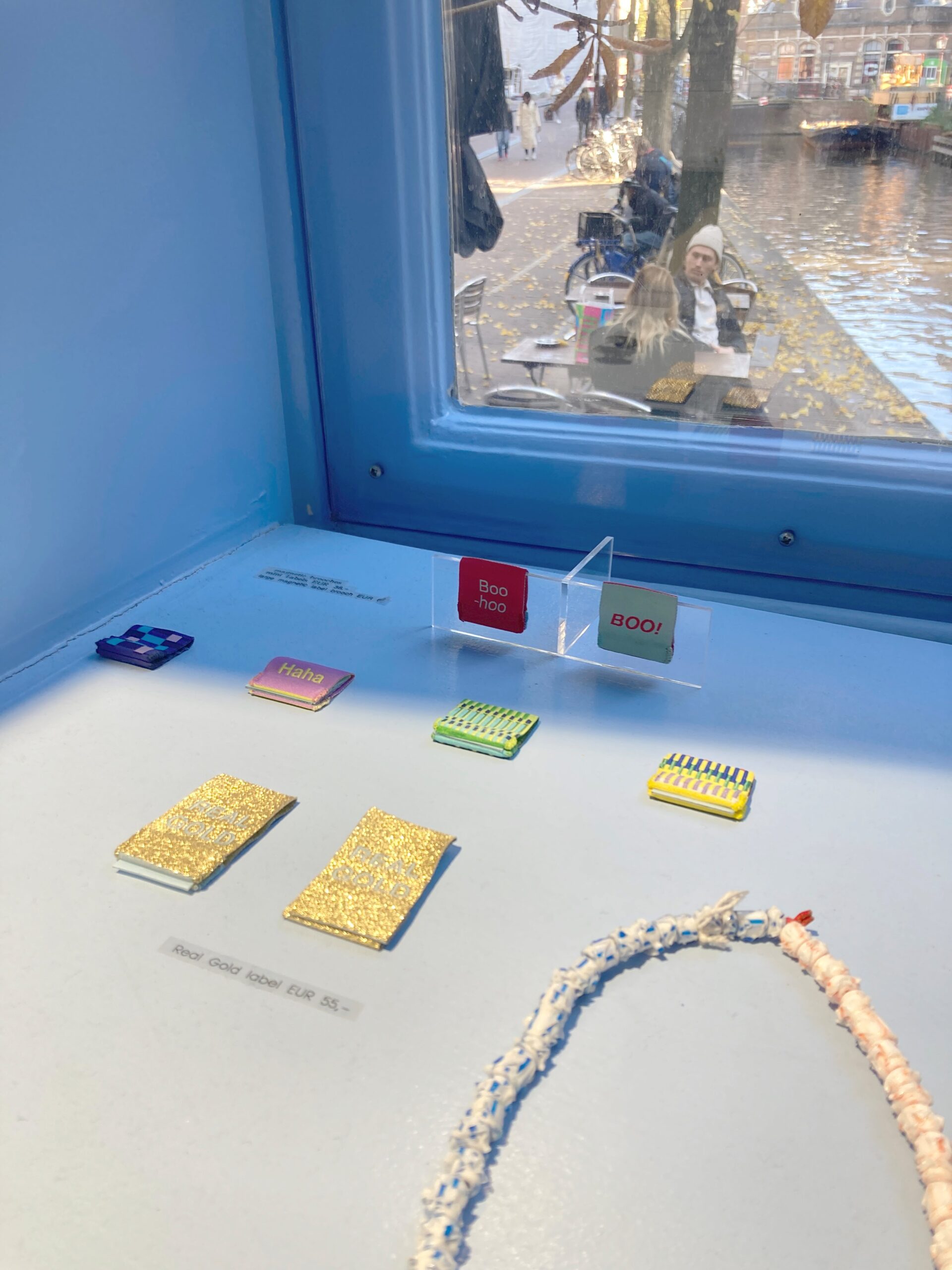
The shop’s concentrated material, formal and conceptual spectrum is wide; Morgane de Klerk presents wooden and textile pins; the “Mini-Labels” series includes small colourful textile label-brooches with a magnetic mechanism. They combine playfulness with textual statement, intended for intuitive attachment to everyday garments – offering a tongue-in-cheek commentary about labels imposed upon us and those we choose to affix to ourselves. De Klerk’s “Rio-Rio” series, pins made from cylindrical wood pieces reminiscent of branches, combines wood carving with steel bending in a delicate colour palette, and explores simplicity as a nuanced value and the aspiration to create accessible objects that transcend age, gender, and class. In contrast, Martina Turini sets gemstones and pearls in silver castings, bends silver or gold tubes into rings and earrings, and strings pearls as though in a traditional hand-beading contest. Her jewellery draws inspiration from nature, archaeological finds, and architecture. Caroline Bach also works from foraged natural elements and observation of seeds, which serve as “diamonds” or gemstones and as organic models later cast in metal. Her works are displayed alongside the seeds and plants themselves, on small tiered pedestals. Ela Bauer regards colour as a substance in its own right, working primarily with resins, polyamide, and various silicones.
This is only a narrow overview of four makers from the collective, through which one can begin to understand the breadth of approaches to jewellery and wearability – idea, material, form, and technique, visible from the collective’s shop shelves.
The encounter emphasized how much the collective functions as a nurturing environment for sharing and learning, strengthening personal and collective identity through joint creation. The professional-economic model in which the collective operates as a community offers real hope for the future of the field and the possibility of preserving the craft sphere in the current reality – especially in the local context of our own culture, art, funding, and industries that are in the throes of decline. Viewed through an Israeli lens, where public funding for culture and art education has been steadily eroded, cultural institutions face political pressure, and local production struggles amid ongoing crises – from the pandemic to war, community-based models such as this collective offer a tangible alternative: cultural, educational, and economic resilience emerging outside institutional frameworks.
The Pool – Amsterdam Jewelry Collective | members: Annelies Planteijdt, Caroline Bach, Cat Priem, Iris Niewenburg, Ela Bauer, Floor Mommersteeg, Gabriella Goldsmith, Sophia Zobel, Marguerite Bones, Martina Turini, Morgane de Klerk, Paul Derrez, Q Hisashi Shibata, Stefanie Verhoef, Triin Kukk
Insta: thepooljewelry
Atelier Anke AMO Akerboom –
Opening of a Retrospective Exhibition of a renowned local figure in jewellery education
I joined the opening of a retrospective exhibition by the jeweller and educator Anke AMO Akerboom in her long-standing atelier for teaching jewellery. The event was attended primarily by her students over the years, most of whom work in other fields for a living, yet maintain a lasting connection to contemporary jewellery as a hobby and as a kind of “food for the soul,” out of longstanding attachment and sometimes decades-long devotion.
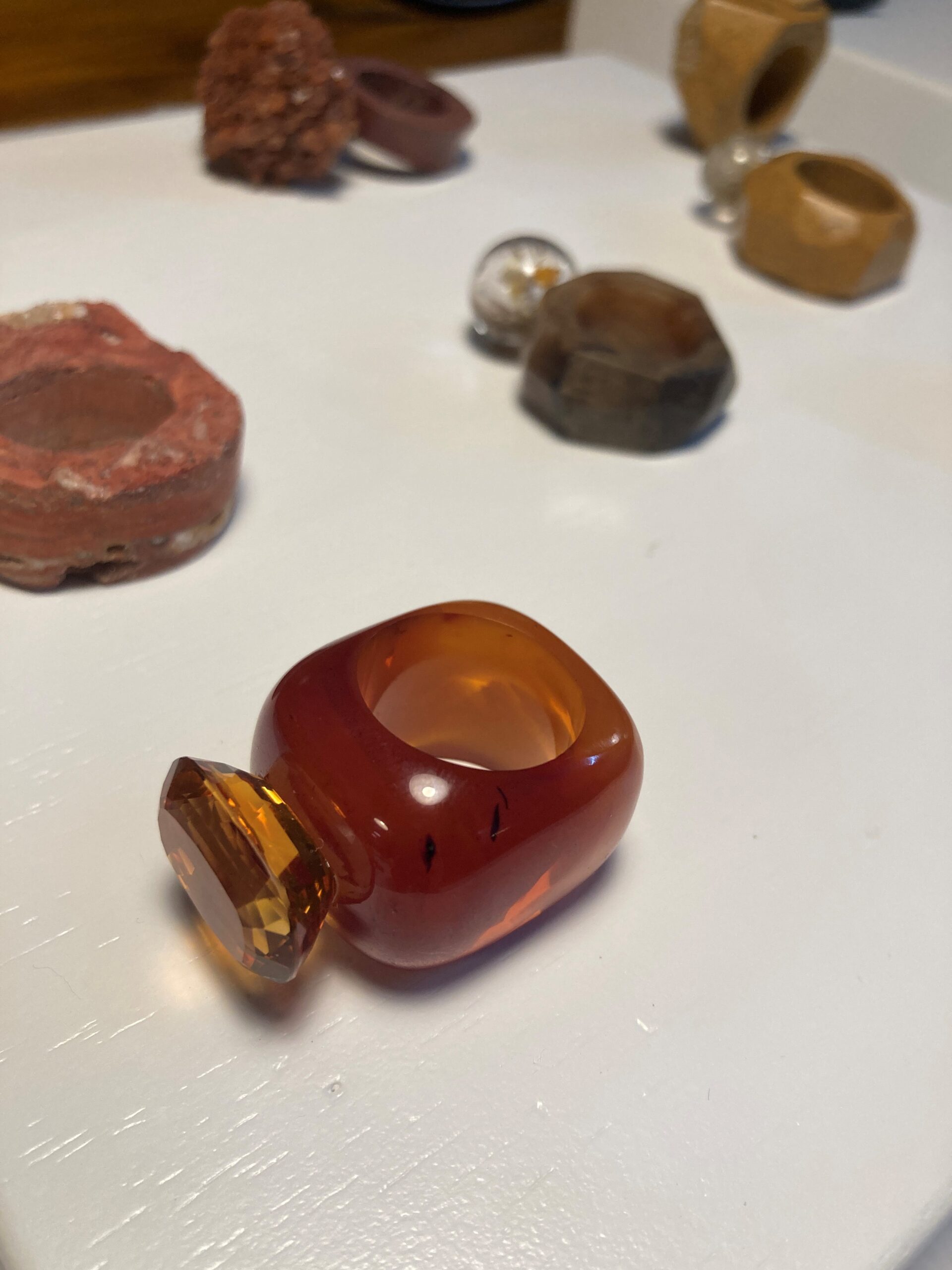
At the centre of the room stood a particularly mesmerizing and iconic piece: the “Facetlight” ring (2022) from the “Inner Earth” (Binnenaards) series. Anke told me she purchased a giant amber bead at the Bedouin market in Be’er Sheva. During drilling and polishing, suspicions arose that it lacked the typical resin scent and its colour had shifted – leading to the conclusion that it was synthetic amber. Yet its colour is spectacular, and combined with citrine without a bezel, it creates a mesmerising optical effect.
It was fascinating to meet an audience of students connected to the field, gathering out of nostalgia and appreciation for their teacher’s work over the years, and to converse about jewellery and creation with profound warmth. Akerboom presented a diverse range of series in their materiality: a set of serving utensils made of folded aluminium in a variety of colours with a minimalist-modernist design; the “For Girls With Balls” necklace series in silver with purple flock coating in various testicle-like forms; and colourful Perspex rings set with stones or riveting settings by pearls – closing the ring’s structure.
Insta: anke_amo_akerboom
FullHouse –
Pop-Up Exhibition, Between Accumulation and Balance
WearHouse studio in Amsterdam is an independent studio and space for contemporary jewellery, functioning as a space for making, research, and display. The studio serves as a platform for jewellery artists to develop works, exchange knowledge, and engage in professional discourse, hosting exhibitions, events, and activities that expand the boundaries of jewellery as a material, bodily, and conceptual practice. WearHouse operates through connection to both local and international communities, placing jewellery within a broad cultural context.
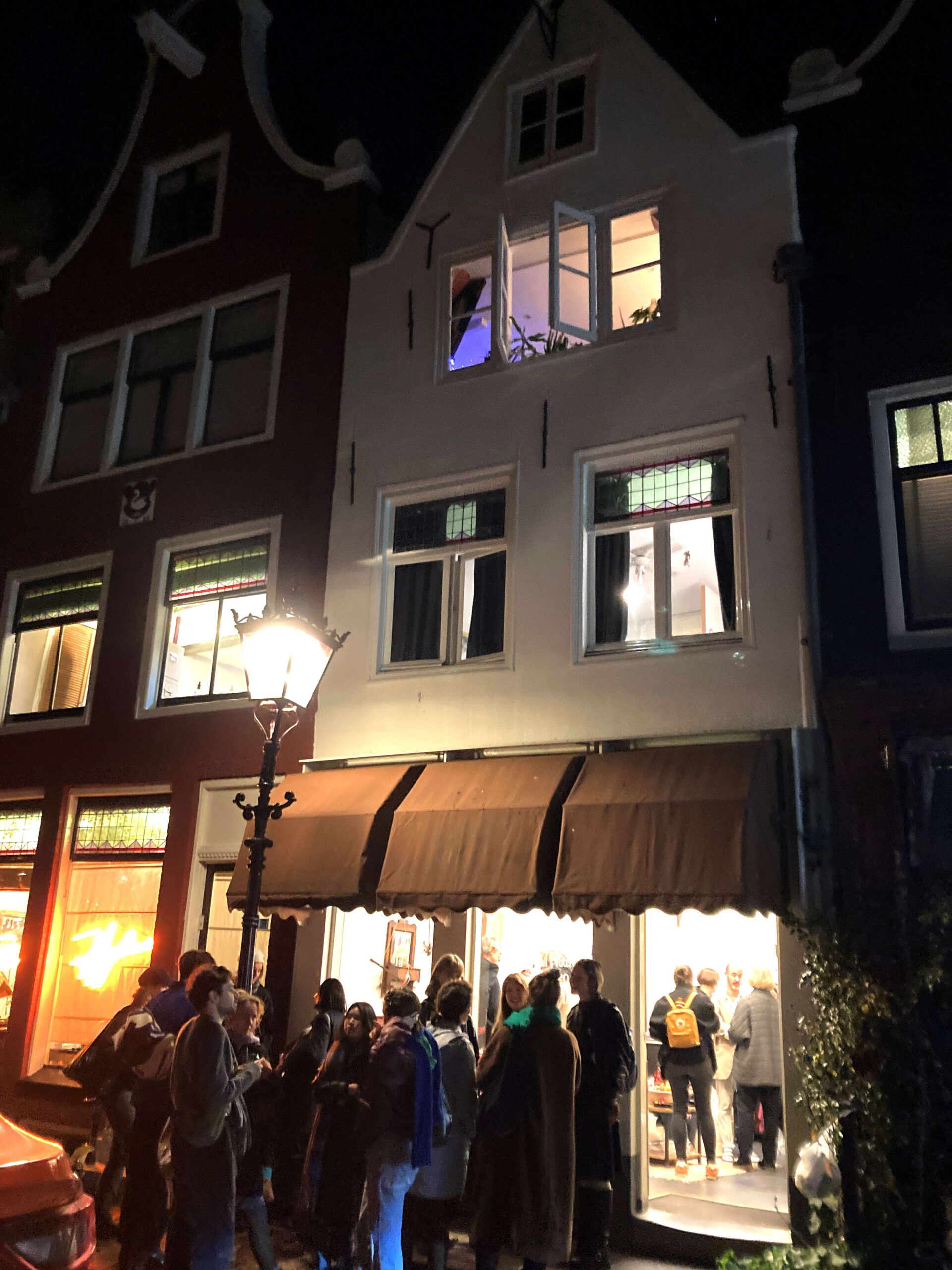
FullHouse is a pop-up exhibition on the theme of lived domestic space, presented in the home of curators and makers Yotam Bahat and Daniel Jirkovsky – not only in the ground-floor studio, as in previous exhibitions, but throughout the entire house. The house, a typical narrow Dutch home, spans three floors. On the ground floor facing the street, a tightly packed yet festive gathering took place; this floor also contained the living room and the studio.
In the street-facing display window, an organic-minimalist work caught my eye: Martina De Vos’s “Cat Mustache” pins. They resemble small plastic bowls or scoops, with cat hair in the centre, expressing chaos through an unexpected combination of synthetic and natural materials, between fragile, asymmetrical lines and the smooth simplicity of plastic, in a dynamic balance that unsettles traditional harmony and beauty.
By the entrance door stood a wood and textile piece by Ziqi Yuan: worn door stoppers made of wood, cotton, textile, and steel transformed into a wearable object – a buttoned shirt collar that grew limbs, with “shoes” made from door stoppers at its ends. The life-sized object bears traces of use and memory and creates attention to the story accumulated within it over time, like a person returning home after a workday, standing in the doorway, marveling at the silence waiting beyond the threshold.
I joined the crowd, trembling with the typical unease of small people in places full of large people, in a crowded space in a big city, and quickly escaped to explore the floors of the house.
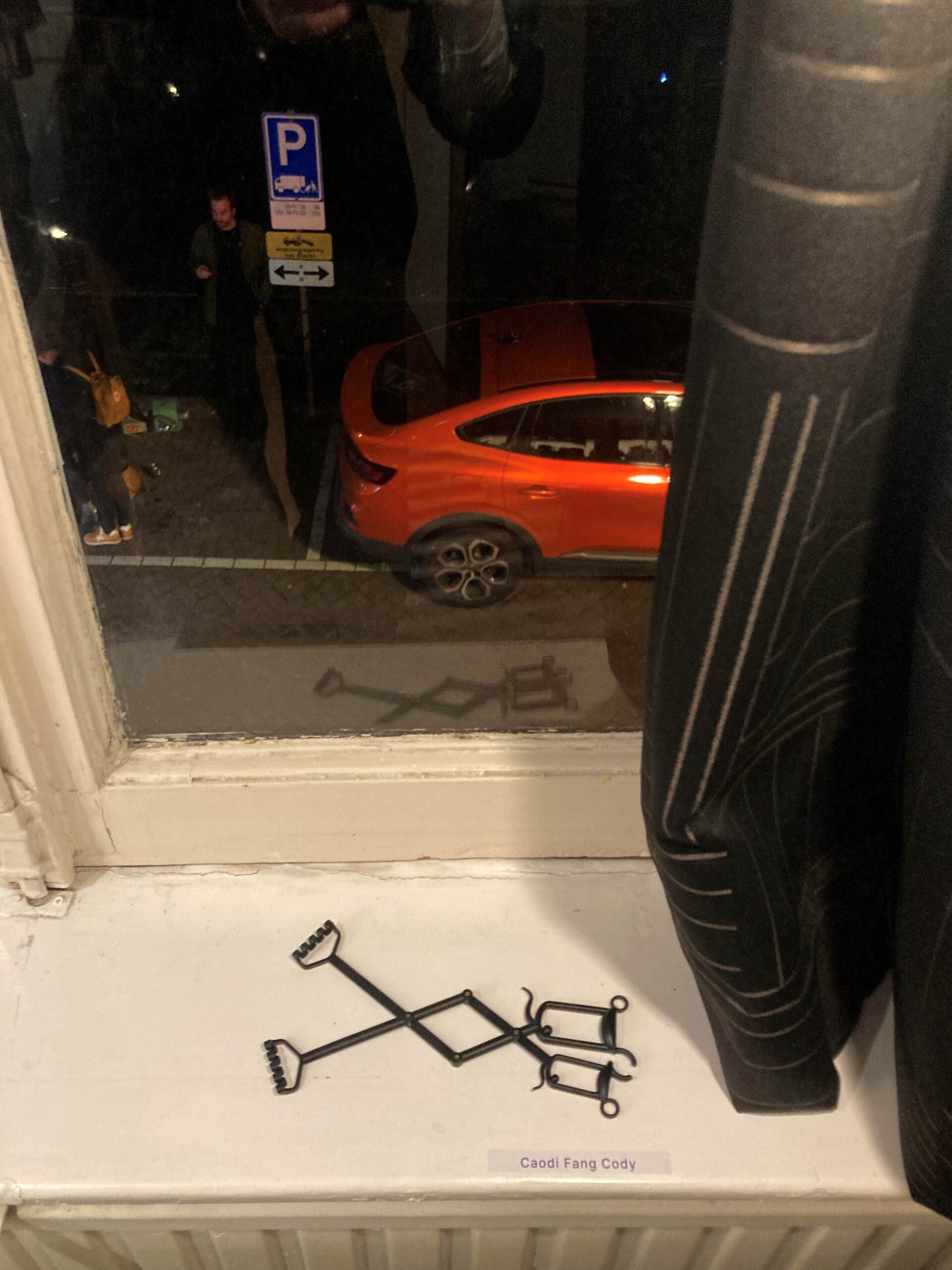
Ascending to the second floor, a kitchen and a single bedroom. The works were catalogued in advance and placed according to the nature of their engagement with different domestic spaces. Some were displayed in isolation, almost sacred in relation to their surroundings – for example, Daniel Jirkovsky’s white porcelain kettle-spout necklace, addressing queer sexuality in the domestic sphere, or my glass tea-bag pendants, inviting contemplation of the dwelling space and the possibility of emotional processing and consolation. In the bedroom, on the window facing the street, a kind of object by Caodi Fang Cody was placed – two frames like rakes for air, attached by a scissor-like handle mechanism, resting at its edge.
Other works were stacked like accumulations of objects, balanced in a way familiar from encounters with personal belongings and furniture in real domestic life. For example, a striking enamel work that brings a smile – a three-dimensional wedge of yellow Dutch cheese on a chain of pastel-blue enamel beads reminiscent of children’s toy studs, by enamel artist and jeweller Maria Kiialainen. The work stood out in its colourfulness among several pieces placed on the narrow kitchen table, also dealing with imagery of food, nourishment, and the rituals of eating and cooking.
Even in the narrow, winding staircases, works were placed with a wink – fleeting encounters on the way up and down. Next to a real fire extinguisher, a large rusted old shelter sign was displayed, into which a chain had been embedded from within; both sides of the shelter box were re-set with gemstone inlays that restored it to a complete box, with a thick rope chain “trapped” inside. Later, I learned that wandering through abandoned buildings and collecting “treasures” that are granted new life with a generous, compassionate gaze is part of artist Sophie Rose’s practice.
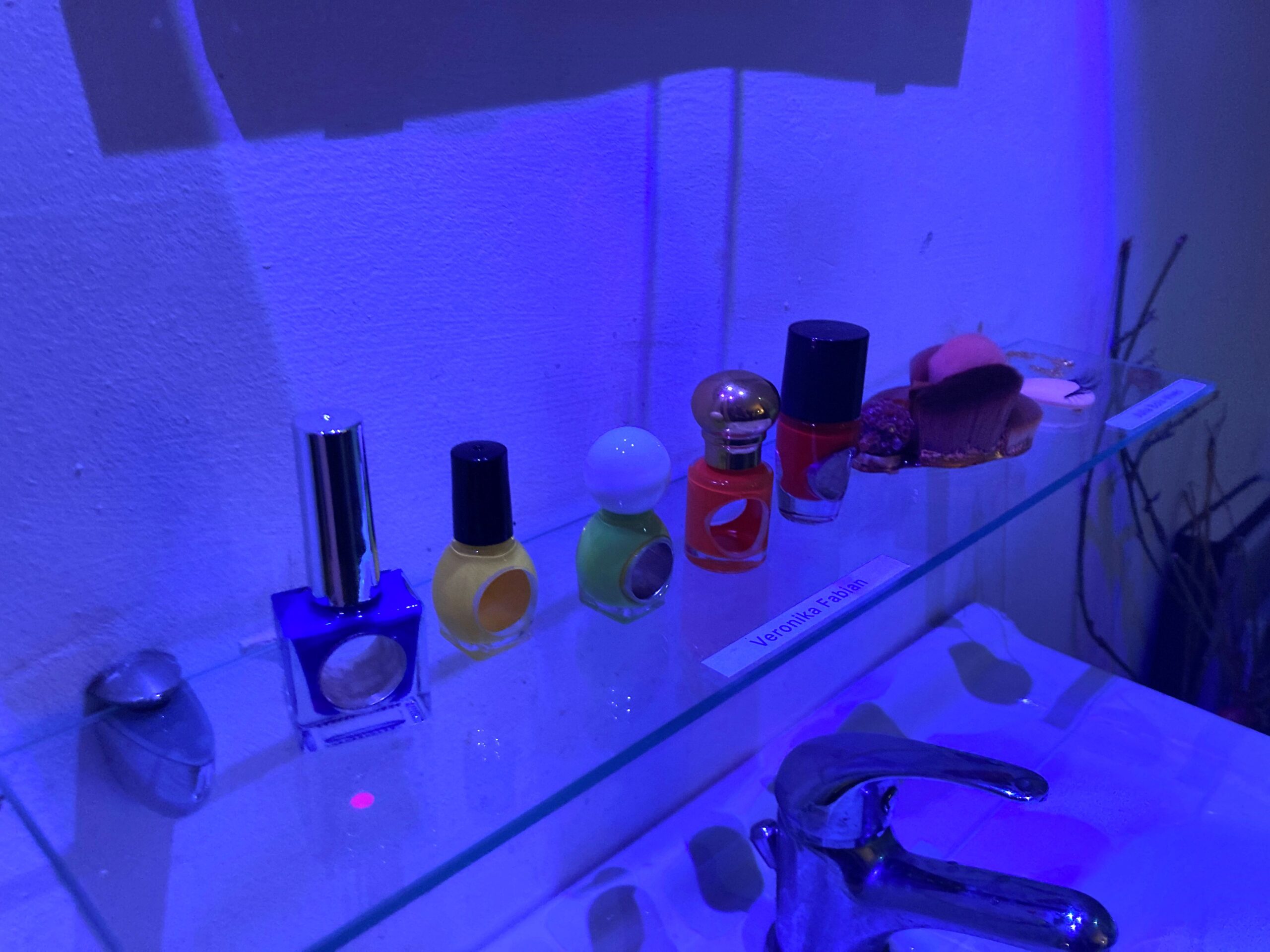
At the top level of the house – a bathroom, a toilet, and an adjacent additional bedroom. The material, conceptual, and humorous range in the bathroom space was wondrous. Some themes allow for a certain release. Beside the sink were displayed: a series of five rings made from bright nail-polish bottles by Veronika Fabian, some of which allow for use and adornment while worn; pins forming a landscape of makeup brush hair in various compositions; and a pendant that is a portrait of false eyelashes by Julia Buix-Vives.
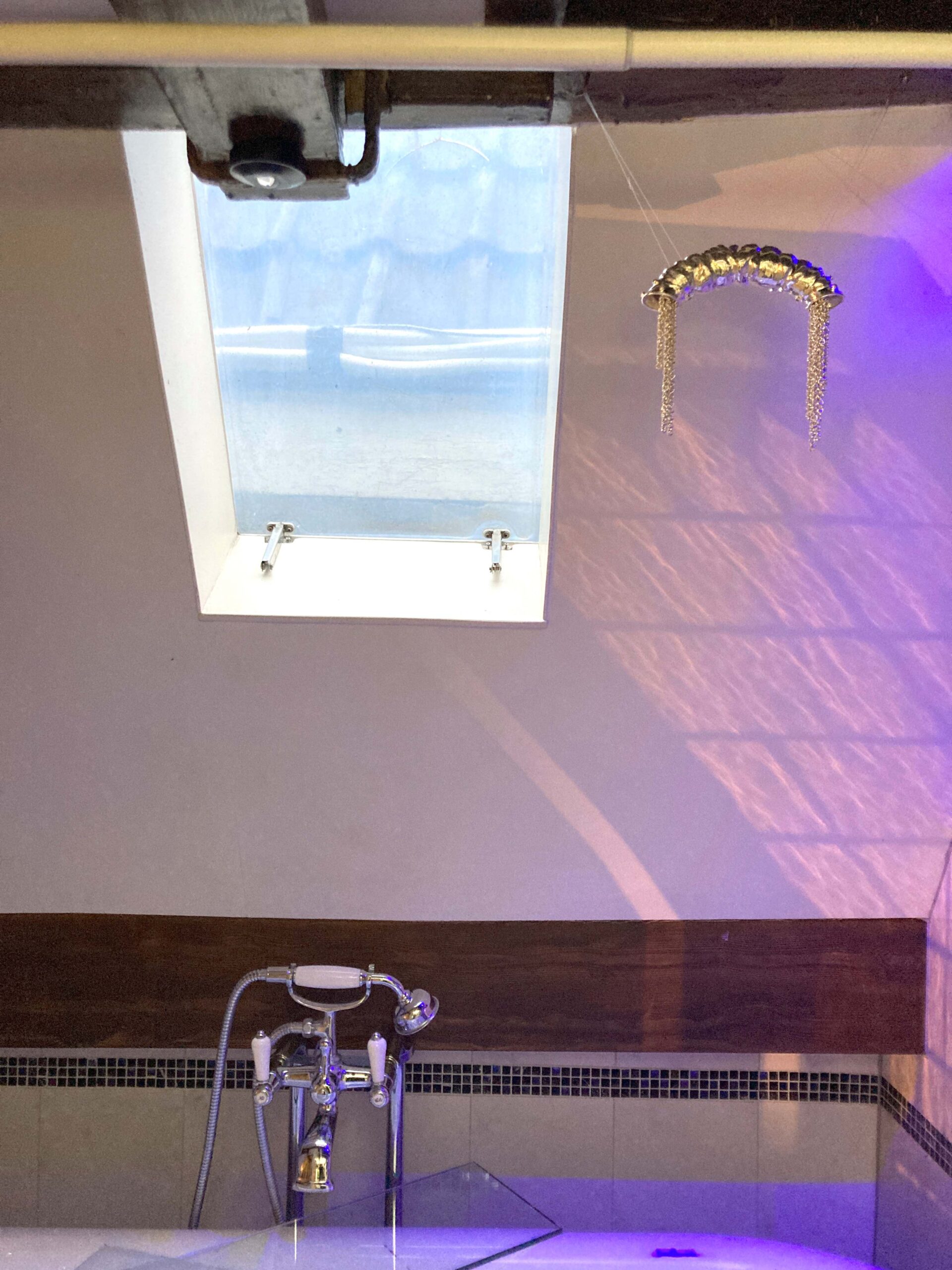
In the bathtub, Joshua Kosker presented pins made from solid soaps in different states of use, mounted on a gold and silver mechanism, along with a square porcelain relief the size of a palm depicting a towel piece with a label on its back; in the background of the mechanism, the inscription “100% cotton” and “made in Pakistan” appeared. Above the bathtub, hanging about a metre above the faucet, was Sitong Chen’s work: a sterling-silver object resembling a bidirectional water stream, with two ends attached to a hand-hold with grooves indicating grip. On a towel rack was displayed an Afro-comb made of glass that I created – its casting unfinished – hung as a pendant on a cotton cord in the colours of supporters and opponents of the Eritrean regime; and by the bathroom entrance, three pendants resembling body substances and tubes in pink, grey, and brown by Brigit Thalau.
Observing objects within the space where a person performs personal rituals around these materials and things raised thoughts in me about priorities, emotional domesticity vs. material domesticity – Do they coexist, does one emerge from the other, or does one come at the expense of the other? And perhaps the most essential question: what is a home? And what is it about a particular collection of objects lying and living between four walls that gives the sense that a place is a “home”?
FullHouse exhibition, WearHouse Studio | participants: Anezka Vanova, Annelies Planteijdt, Brigit Thalau, Caodi Fang Cody, Daniel Jirkovsky, Danni Schwaag, Deganit Stern Schocken, Ela Bauer, Elise Hoebeke, Erik Lijzenga, Eunhui Stella Lee, Feifei Cheng, Floor Mommersteeg, Gesine Hackenberg, Henrike Altes, Hilde De Decker, Into Niilo, Jeannette Jansen, Juan Harnie, Julia Boix-Vives, Joshua Kosker, Kamile Staneliene, Maja Stojkovska, Maria Kiialainen, Maria Luisa Melendo, Martine De Vos, Miriam Arentz, Naama Ben Porat, Namuunaa Ganbaatar, Niyousha Moosavi, Paula Huizenga, Paul Derrez, Philip Sajet, Silke Fleischer, Siobhan Ledden, Sitong Chen, Sophie Rose, Veronika Fabian, Yinuo Yu, Yotam Bahat, Yusi Wang, Ziqi Yuan
Insta: studio_wearhouse
On my way back, I met Sophie Rose from Denmark and Josefína Urbánková from the Czech Republic, and a conversation developed between us about materials, work processes, and learning through making. The conversation naturally attracted other people, and at its end Sophie and I continued on a night walk, during which a meaningful discussion unfolded for me about professional presence beyond the studio. At the same time, questions arose about balancing professional practice, partnership, biological time, family, and the tension between living in a quiet, enabling periphery and a large city rich in culture and creative community. The conversation did not seek conclusions; it took place as a sincere sharing of dilemmas and experiences that, despite geographical distance, seemed close in their essence.
The Rusty Nail – A studio reimagined as a bar for the festival, for two days only
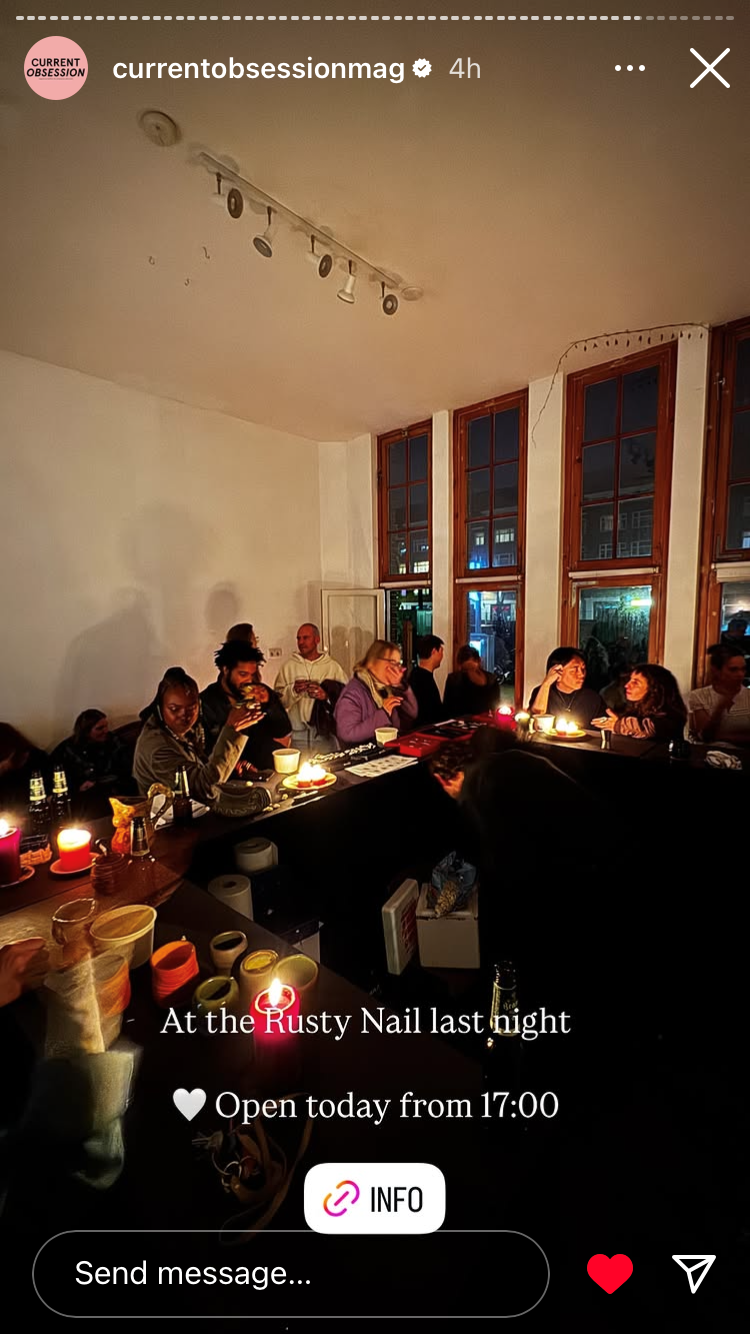
We arrived around 22:00 at The Rusty Nail, the space of Göran Kling and Julia Walter, a hidden, imaginary bar where cocktails are served in handmade cups. The space was transformed for two consecutive evenings only – an event hybridizing hospitality rituals with artistic practice. It was a nightly meeting point for the participating jewellers and makers, a space celebrating the dark season of the year, with warming drinks and jewellery as talismans. The entrance to the bar was only through the window, via a dedicated A-ladder. Inside, lit only by candlelight, we saw a bar in a U-shaped structure and shelves with cups on the wall opposite the window. On the bar, a variety of rings and pendants in silver and Silver Clay with settings were displayed, alongside a limited menu of two cocktails and beer.
Each visitor chose a favourite cup from the shelf display, approached to order a drink, and at the end received a ceramic “rusty nail” to stir it in the glass. Each cup bore a price marked on its bottom, and beside them was a sales binder on the shelves. We “rusted” with joy – material fatigue quietly announcing that the day was drawing to a close.
Insta: juwalter.ananas.bananas | goran.kling
Obsessed! Web: obsessedwithjewellery
- OBSESSED! (obsessed with jewellery) is an international festival of contemporary jewellery initiated by CO, functioning as a multi-focal curatorial platform in the Netherlands and Belgium for four weeks in November. The festival takes place in diverse urban settings: galleries, museums, studios, and temporary spaces – using the city as an active stage rather than a neutral backdrop. This structure allows exposure to a wide range of approaches, materials, and positions within the contemporary jewellery field, and highlights the discipline’s broad scope and its relationship to art, design, and material research.
↩︎ - CO (Current Obsession) is a research platform and an independent curatorial organization operating as a magazine, promoting critical discourse around contemporary jewellery. Through publishing articles, exhibitions, events, and festivals, CO subverts the boundaries of the traditional field and establishes jewellery as a creative domain of knowledge concerned with questions of body, material, culture, and contemporary context.
↩︎