The current issue seeks to touch upon the topic of the market within the field of jewelry-
making, through a dual perspective. On one side – raw materials: their origins, extraction,
processing, and the meanings they carry; and on the other- the ways in which objects and
jewelry reach audiences of viewers and users. These two points of view trace the
moments in which the creator is no longer the sole party responsible for the work. After all,
the material arrives following an entire supply chain, and after creation – the finished work
continues onward into the mediating space of the gallery. What happens next? Whom
does the object encounter, how is it handled, and what meanings emerge from it?
We open the issue with the article “Gold on the Table״, which delves into the material
and the market’s origins – the place where everything begins. The article offers a brief look
at gold mining, its path as a raw material, its technological and historical aspects, and the
ethical and cultural contexts that accompany it, from the moment the material is extracted
from the earth for processing, to its transformation into an object moving between hands,
bodies, and systems of value. Although contemporary jewelry employs a wide variety of
materials, we chose to focus on gold as an established, charged, and at times painful
example. It is, of course, not an exceptional case: the mining of gemstones, diamonds,
and many other materials also raises questions that require research, scrutiny, and the
formulation of a position – with the hope of improving our relationship with materials and
with the environment.
Later in the issue, we present interviews with three owners of contemporary jewelry
galleries from around the world. These conversations reveal the mediator’s perspective:
How do galleries understand and shape the encounter between art object and audience?
What challenges does a gallery in this field face? Which expectations, changes, and
trends dictate the ways in which jewelry and objects are received, acquired, and
preserved? Thus, the other end of the market unfolds – the place where jewelry-making
meets the gaze of the public, the touch of the body, collecting, and patterns of use.
Together, the two articles offer a broad view of the field of metalwork and jewelry, aiming to
deepen our understanding of the professional practice and of the broader contexts within
which it takes place.
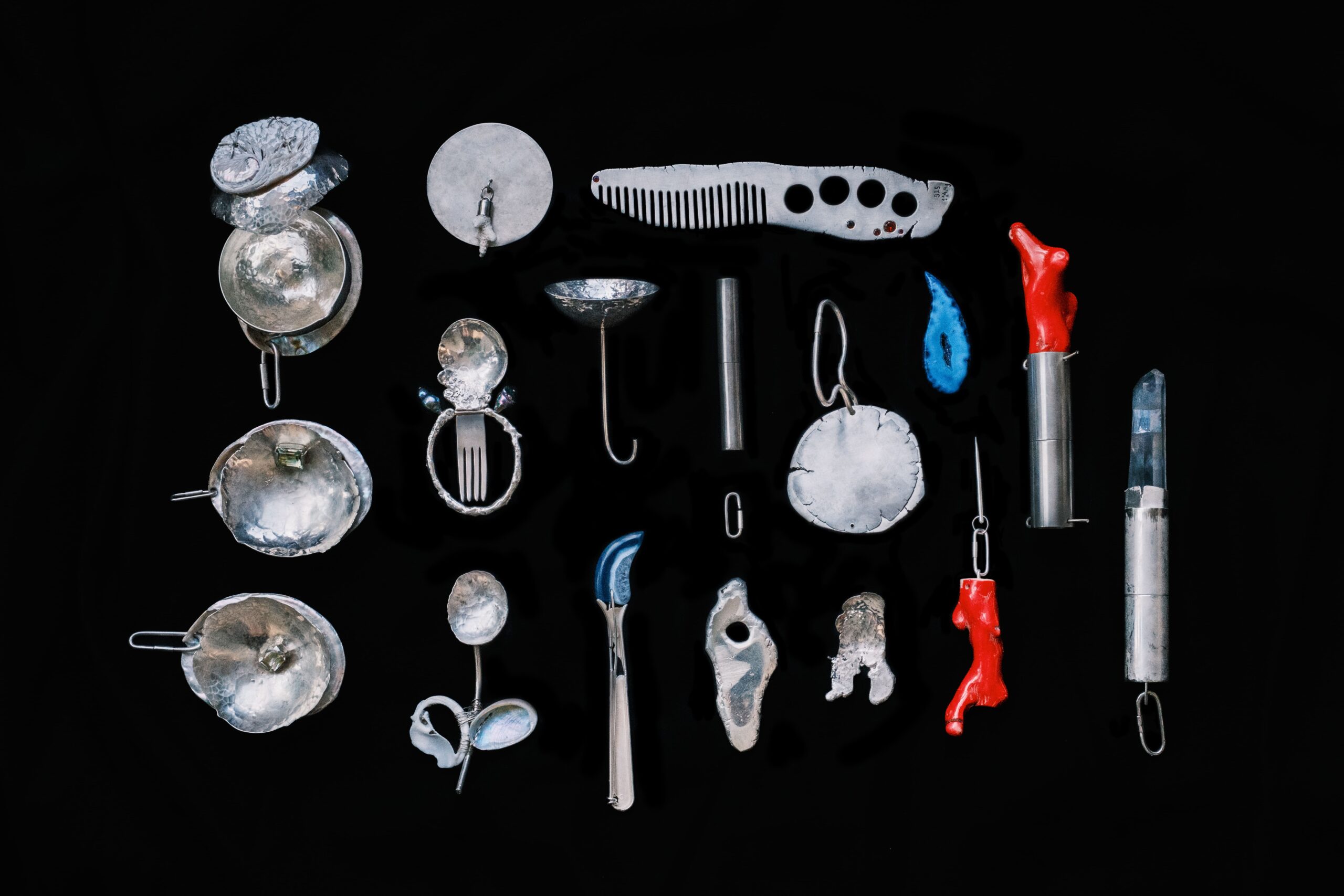
Zakharova Sofia, Kesef, 2024, wearable objects.
925 silver, 999 silver, oysters, coral, black pearls, quartz, garnet, zircon, agate
In a changing world and dynamic reality, household objects gain emotional and survival-economic value. The jewelry set created by Zakahrova provides essential support for the body and mind amid mobility and displacement.
Photo by Nikita Marshanov