On the stage of the darkened auditorium at the Israel Museum in Jerusalem, before an audience of approximately 300 metalsmiths, the Museum’s Deputy Director, Dganit Senker-Lange, shared a lighthearted admission: “Honestly, I never thought I would speak at a jewellery conference.”
This brief moment distilled the significance of the event, and the entire “Contemporary Metalsmithing and jewellery Events 0.01”, as a move toward establishing a fertile, living discursive space for contemporary jewellery: a field with its own history and questions, rooted within the art field in Israel.
The event – organized by Association members Noy Alon, Anat Golan, and Na’ama Haneman, alongside the museum’s curatorial committee, which included Miki Joelson, Sharon Weiser-Ferguson, Ahiad Ovadia, and Rami Tareef – marked a first-of-its-kind collaboration between the Association for Contemporary Metalsmithing and jewellery and the Israel Museum. While academic seminars in the field are common at Bezalel and Shenkar, the uniqueness of the event lay in its organic growth from within the field itself, representing an independent community voice. In her opening remarks, Association Chair Prof. Einat Leader described this as a moment of gathering and self-reflection: “A time when a community chooses to pause (…) and position its practice within the broad fabric of culture and society.”
The tone was set at the entrance, before a single word was uttered, through a small material gesture: round metal pins featuring the Association’s reddish logo were distributed and immediately fastened to lapels. A simple pin became an instant marker of belonging – an object encapsulating a community and a shared moment for a field converging upon itself.
The audience reflected the breadth of the field: Association members, colleagues, and students from Bezalel, Shenkar, and Tel Hai who arrived on organized transportation. Joined by museum professionals – including five curators and two conservators who led panels, workshops, and tours – this human mosaic testified to the depth of the dialogue taking shape.
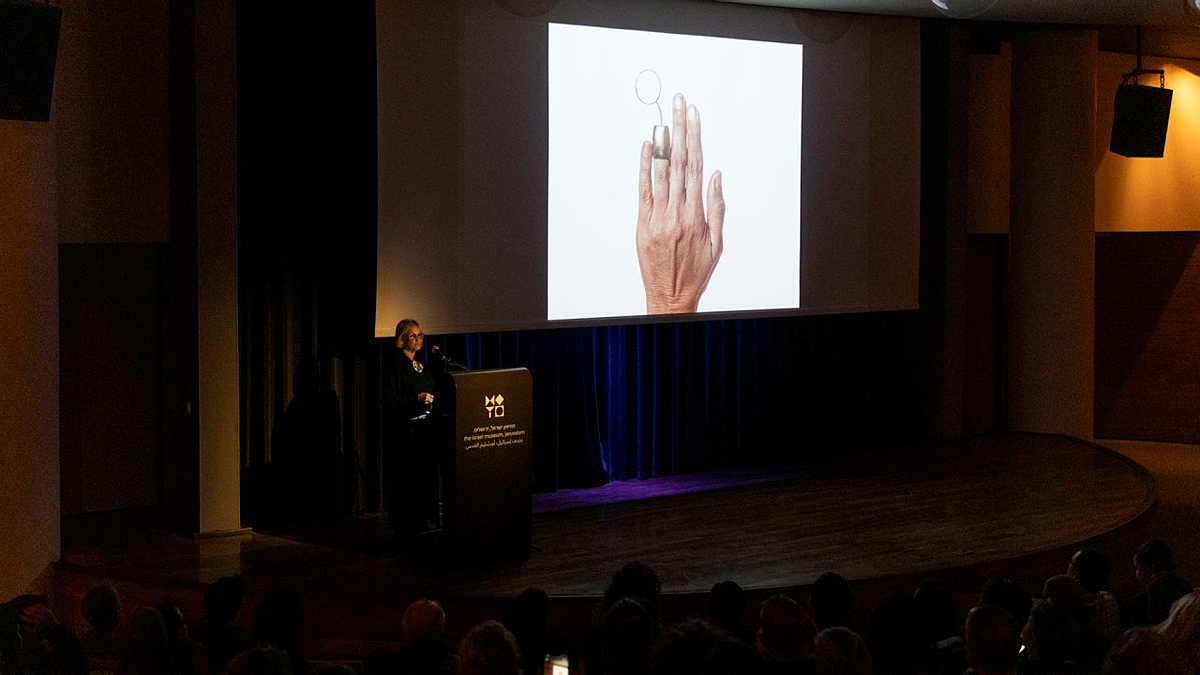
Jeweler and artist Dania Chelminsky speaking at “Jewellery and the Message,” the first joint conference of the Contemporary Metalsmithing and Jewellery Association in Israel and the Israel Museum
Photo © The Israel Museum, Jerusalem, by Zohar Shemesh
Jewellery as a Carrier of Meaning
Throughout the day, multiple perspectives on jewellery unfolded. In a mesmerizing AI-generated work by Noa Tamir, titled “The Contemporary Jewellery: Past, Present, Future,” local jewellery evolution came to life – from Epipaleolithic pendants made of animal teeth to contemporary paper and plastic pieces.
The work recalled how, throughout history, questions of material, culture, and perception have been repeatedly reformulated, emphasizing that jewellery is a medium through which we contemplate the world.
Several lectures revisited the jewel as a carrier of meaning. Miki Joelson, associate curator in the Wing for Jewish Art and Life, discussed amulets bearing a dense system of symbols, wishes, fears, and hopes. Metalsmith and video artist Daniella Saraya examined the tension between the “stable jewel,” symbolizing an aspiration toward eternity (gold, diamonds), and the human body’s temporality and vulnerability. Shifting from traditional metalsmithing to action-based video jewellery, Saraya uses living, perishable materials such as flowers and traces on skin to replace values of fixity and endurance with those of emotion, movement, and change. Her works are not static objects but living, pulsating bridges linking bodies, inner experience, and shared human space.
The reflections on creative processes were equally captivating. Jwana Ghanadry, a recent Shenkar graduate, presented her final project, where she transformed a vivid imagination inspired by underwater life into jewellery of striking presence. Her pieces combine 3D printing with traditional metalsmithing, embodying a dual message – empowering yet constricting. Na’ama Haneman shared her evolving relationship with metal as a material-philosophical quest: beginning with large-scale traditional raising techniques, progressing to digital simulations that generate encounters between forms, and culminating in works that seek to embed the experience of metal having “a life and desires of its own,” where the maker must listen rather than merely control.
Dania Chelminsky shared a harrowing moment in her studio that became a pivot for her work: while polishing a chain, her finger was caught in a link, resulting in a partial amputation. She spoke of the studio as a space of healing and of jewellery as an object that holds both fracture and time. She presented two bodies of work addressing this experience: in one, she sutured severed tree branches using jewellery techniques in an intuitive process, producing three final models a day. In the other, “Completions,” she created poetic prostheses for herself, combining humor and new functionality – such as a magnifying glass set in place of a joint, or a cushion for sewing pins.
Chelminsky proposed viewing jewellery as an act of suspension: not a solution to fracture, but its containment. Repair, for her, is not an attempt to erase the fracture, but a force that grants new life to both body and object.
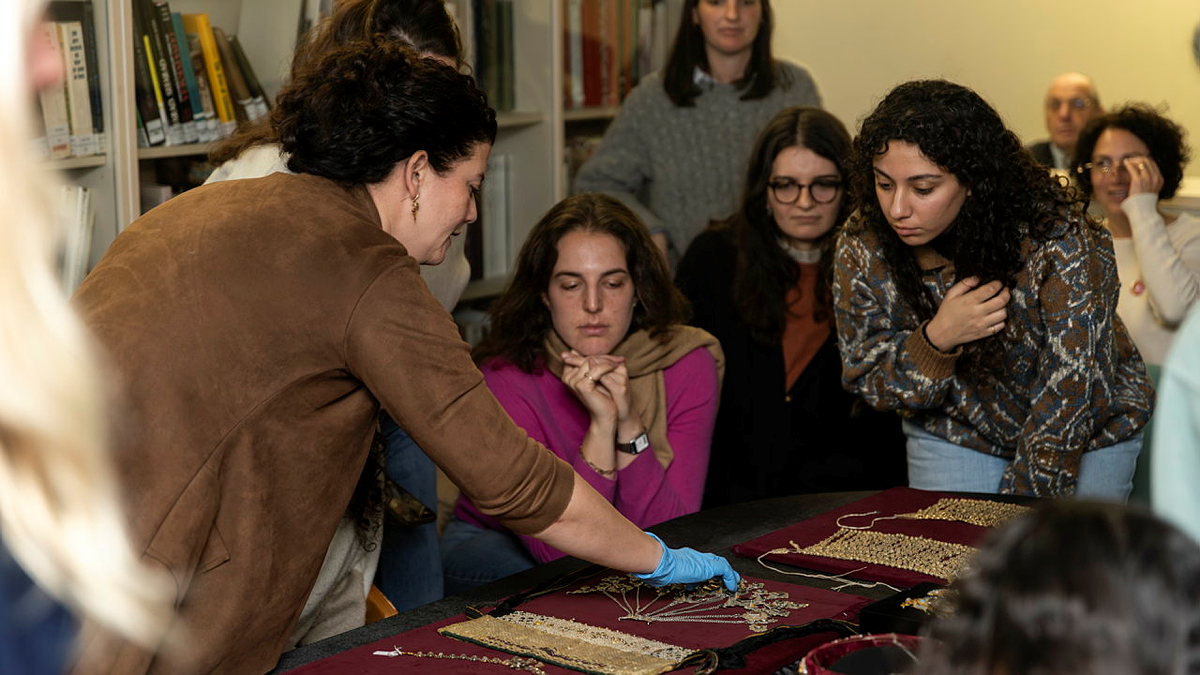
Photo © The Israel Museum, Jerusalem, by Zohar Shemesh
Between the Beautiful and the Monstrous
In the second panel, moderated by Orina Parente, the debate over aesthetic beauty emerged as one of the day’s most charged topics. Prof. Tamar El-Or, an anthropologist from the Hebrew University, framed beauty as a central characteristic of jewellery. In a slide, she presented side-by-side images of Yemeni jewellery, which she described as representing the past of Israeli jewellery, and the Israeli jewellery brand Agas & Tamar, which she defined as representative of the present, arguing that jewellery is, first and foremost, something beautiful that we desire to wear.
In response, Shirly Bar-Amotz, a senior lecturer at Bezalel, argued that the essence of jewellery is not “being beautiful,” but the ability to respond through it – to express a position, thought, or emotion. “I really want to make beautiful things, and they come out ugly,” she remarked. “Each time the motivation is to make something beautiful, and again it comes out monstrous.”
For example, a brooch from her series “Only Bones Will Remain” evokes an abandoned bird’s nest filled with bones, coated in skin-toned silicone, linking it to the wearer’s body and producing attraction and repulsion simultaneously.
For Bar-Amotz, jewellery is her activist medium: “I’m not someone who reacts in an activist way to things that disturb me in society – not enough. So my field, metalsmithing, is the way in which I can respond.”
The murmurs from the audience in response to El-Or’s remarks testified to how charged this issue remains. For many, a narrow aesthetic definition of beauty feels detached from contemporary jewellery, which operates from a much broader conception of beauty – one that includes symbolic, cultural, and other meanings. In this sense, the entire “0.01” event series provoked, in various ways, a discussion about what jewellery is and whether, or how, its beauty is expressed.
Ahiad Ovadia, curator of prehistoric cultures, noted that the earliest jewellery ever found – primarily bones, teeth, and shells – served not only for adornment, but also as social and symbolic markers of identity, belonging, and ritual, and even for connections between different groups.
One can therefore view ancient jewellery as a kind of material-based lingua franca that enabled connection across differences – not so different, perhaps, from the small pin distributed at the start of the conference.
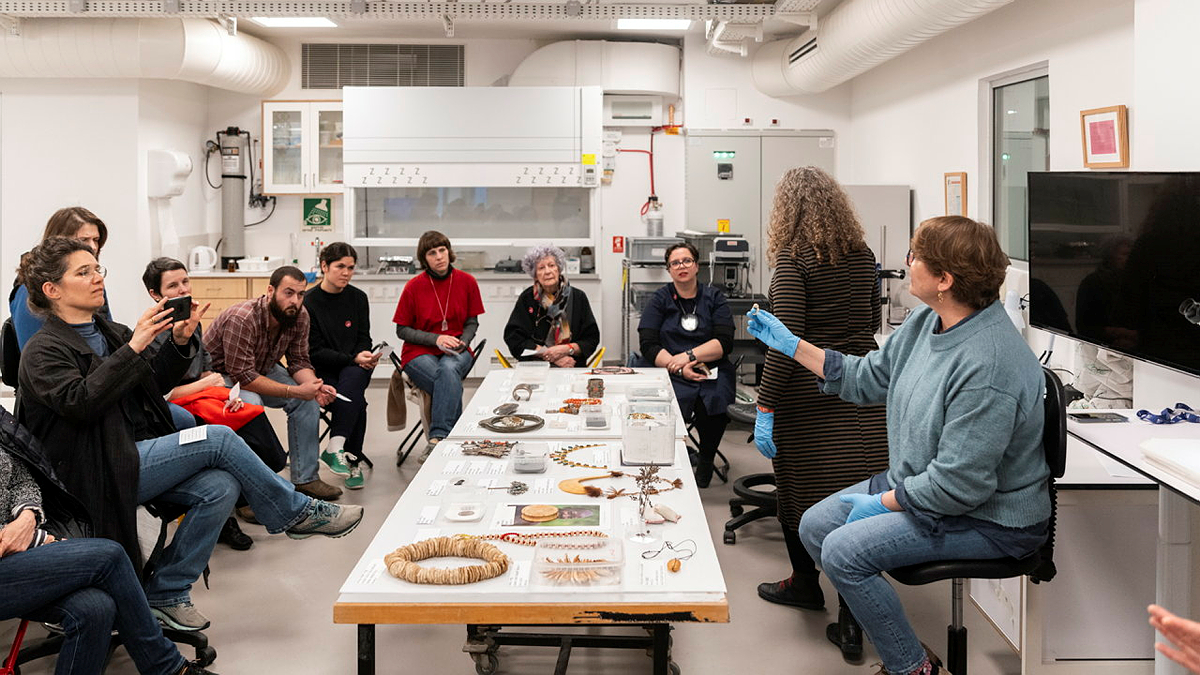
Photo © The Israel Museum, Jerusalem, by Zohar Shemesh
What Will Remain of Our jewellery?
Anat Golan and Bar-Amotz, both engaging with national and Zionist symbols, presented divergent stances. Golan proposed deconstructing military symbols to recharge them with contemporary relevance, Zionism, and patriotism. She said she did that so that she could “raise children here who will most likely enlist in the army in the future.” Her works included showcasing a large, grotesque “Hai” curb chain (gourmette), made entirely of olive wood, a material that changes over time through oxidation or the secretion of its natural oil; and military-style candy-shaped brooches, made of copper coated in yellow Teflon, a material used for weapon coating. These candies, she noted, represent the community “showering” the individual with blessings during Jewish rites of passage. She created this limited edition to emphasize the public’s mobilization for the return of the hostages,” she said.
For Bar-Amotz, however, the engagement with these symbols is laden with grief, pain, and critique, questioning the national and environmental legacy we leave behind.
Asked by Parente how archaeologists two thousand years from now might interpret today’s jewellery, Ovadia replied, referring to industrial jewellery: they would think we all shopped at the same store.
The question of “what will remain” of our material history – including the mountains of waste we leave behind – hovered over the discussion as a very tangible material concern. Ovadia noted that our era is but a thin archaeological stratum. We call it the “Silicon Age,” but it is a distinctly self-congratulatory term. In reality, it is the Plastic Age. As Bar-Amotz succinctly put it: plastic is what will remain of us.
I am not sure what will remain – but something clearly converged.
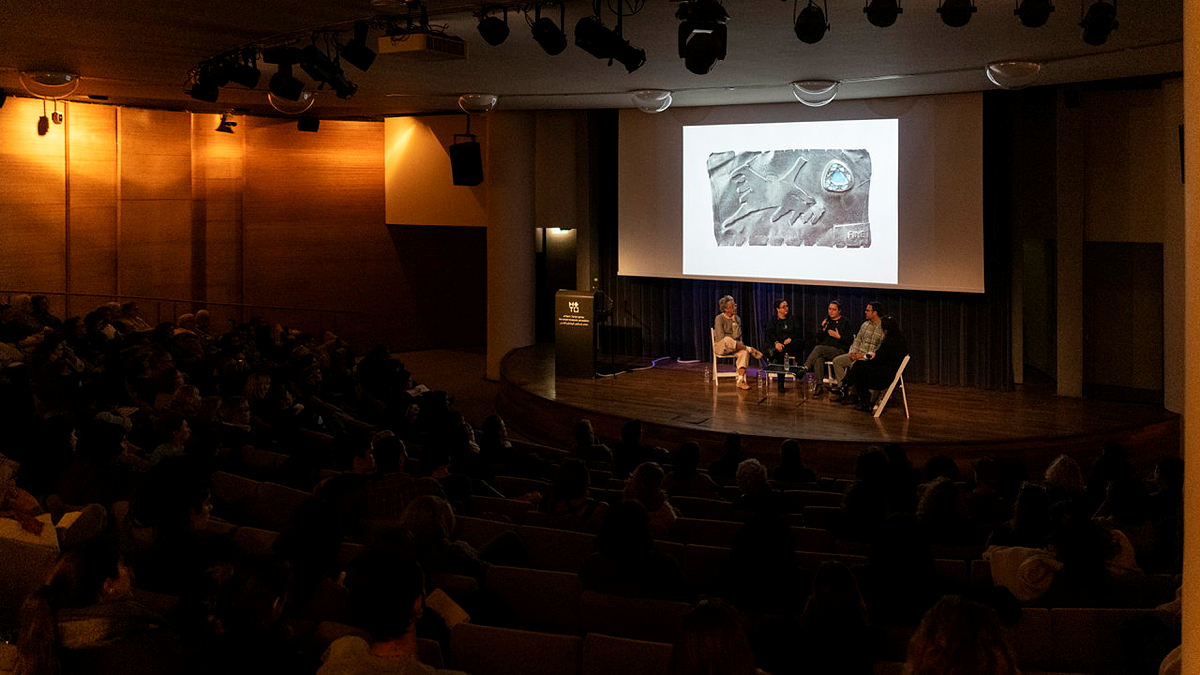
Photo © The Israel Museum, Jerusalem, by Zohar Shemesh